Our brain controls our thoughts, emotions, and behaviour through a complex network of neurons. Sophisticated brain imaging techniques like fMRI help neuroscientists monitor activity patterns in different brain regions, but analyzing the data requires advanced analytical tools.
A popular approach is to map brain imaging data onto simplified physics-inspired models from statistical mechanics. The goal is to capture the essence of how brain regions interact and determine if the brain resides in an optimal “critical” state on the edge of disorder and order. Criticality could explain how the brain balances stability and flexibility.
Through a rather serendipitous journey, in the last few years, I have ended up supervising the work Max Kloucek, a Physics PhD student interested in investigating the connections between criticality in neuroscience and criticality in statistical mechanics. Max’s thesis focuses on exploring specific algorithmic routes – based on inverse Ising modelling – to reconstruct an effective network of interactions from raw time series. The crux of the problem is not just to find a mapping (there exist many different ways) but to do so without fictitiously enhancing the correlations existing in the datasets.
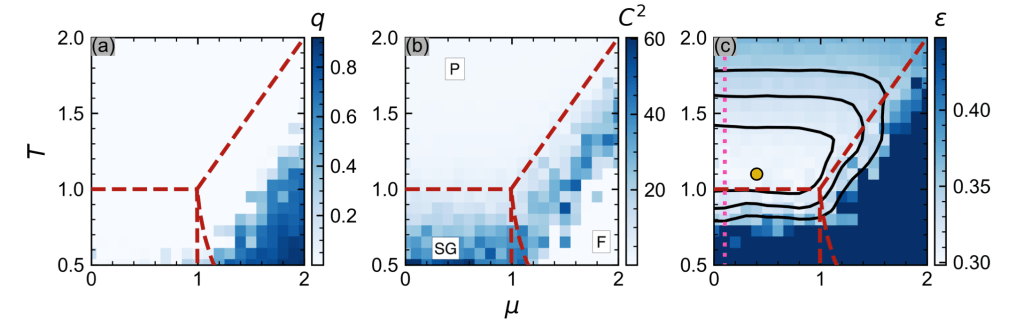
Indeed, a key finding of our work is the realisation that the inferred networks tend to overestimate the closeness to criticality of model and realistic systems. This effect is particularly severe when considering limited datasets, a situation that occurs in underpowered studies as well as when subsampling larger datasets according to different traits (e.g. gender, age etc.) or tasks. For example, we have shown that when comparing cohorts of different sizes performing (or not performing) mindfulness meditation, the directly inferred networks suggested a difference in the distance from criticality that disappeared if suitable statistical corrections that we have devised were employed.
Our work constitutes a caveat on the blind usage of inverse inference models and provides ways to strengthen a correct their predictions even for small datasets.
It has been recently published in Phys. Rev. E . Full reference:
 Francesco Turci
Leave a comment