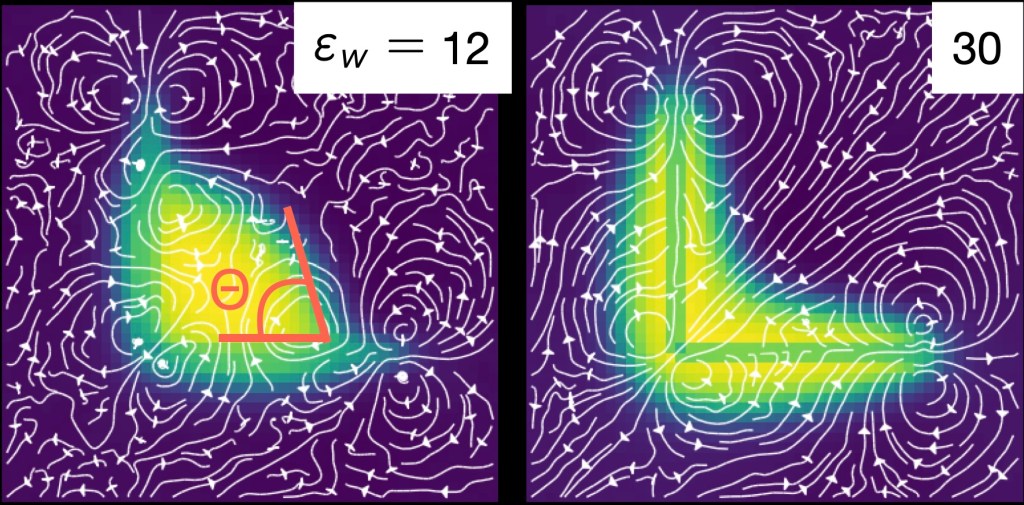
As mentioned in a previous post, self-propelled particles tend to accumulate at boundaries. When combined wit the ability of some active particles (e.g. active Brownian particles) to phase separate in a dilute (gas) and dense (liquid) phase, this accumulation can be seen as the manifestation of complete wetting.
Complete wetting, in ordinary matter, is equivalent to a droplet that spreads with a zero contact angle: essentially, no droplet at all!
This intuition suggests, therefore, that active matter would hardly form any droplet on a repulsive substrate: it would (and it does) spread out and wet the entire surface.
The challenge is to devise an interaction between a substrate and an active fluid that can promote droplet formation. Developing earlier ideas, I have recently shown – together with Nigel Wilding in Bristol and Robert Jack in Cambridge – that it is possible to observe such droplet formation dynamics in an active system by using external potentials that stabilise droplet formation with non-zero contact angles. Interestingly, the qualitative features of such droplets are reminiscent of the equilibrium case in terms of their geometries and their density fluctuations. However, the mechanisms that bring them to life are exquisitely nonequilibrium, with complex flow patterns formed around the obstacles.
Since the contact angle, in equilibrium, is linked to the surface tensions between ga, liquid and the substrates, tuning it with various potentials provides us with a route to test different metrics of tension and understand how the apparent equilibrium-like nature of the droplet profile emerges from the coarse-graining of the particle-based, mechanical picture.
This work has been recently published in Soft Matter.
F. Turci, R. L. Jack, N. B. Wilding, Partial and complete wetting of droplets of active Brownian particles. Soft Matter 20, 2060–2074 (2024). DOI: 10.1039/d3sm01493b
 Francesco Turci
Leave a comment